


 English
 عربى
 中文简体

Galvanized Appliance Components
Galvanized components for home appliances are constructed from high-quality engineering plastics, specifically poly...
Content
A distributor in Muscat orders 500 manual visualization reusable insulin pens, and six weeks later the first complaint arrives: nurses cannot tell whether the dial stopped at 12 or 14 units, so they re-dial and discard insulin at the end of every shift. The pen body is not the problem. The visual scale and the priming routine are.
The short answer: a manual, visualization-first reusable pen is a sensible fit for high-volume, cost-sensitive diabetes programmes, but only when three things are settled before the purchase order is signed. First, whether the dose window can be read at arm's length in real clinic lighting. Second, whether staff will actually run a priming shot every time. Third, whether cartridges, needles and spare bodies will still be available in year four. The sections below explain why each of these matters, and what to put into the tender document so that the answer is on paper rather than in a sales brochure.
On a manual pen, the user supplies the force and the judgement. There is no motor to stop at the right number and no display to confirm it. The window, therefore, carries the whole safety argument: it is the only place where the intended dose and the delivered dose are compared before the needle enters the skin.
Manual operation is also a maintenance advantage. Mechanical pens fail in visible ways: a stiff dial, a slipping clutch, a plunger that will not retract. Electronic pens fail in quiet ways, with a battery or a sensor. For a rural clinic with no service technician within 300 km, a failure mode you can see and describe over the phone is worth more than a feature list.
Skill dependence. A pen with a 1-unit increment and a 60-unit maximum asks the user to count graduations and to hold the button for a full ten seconds after the plunger bottoms out. Both steps are easy to teach and easy to skip. Buyers who assume the device enforces accuracy are the ones who end up with the complaint described above.
A reusable pen moves the cost from the device to the consumable. One moulded body, cartridge changes every few days, a fresh needle per injection. For a patient injecting for fifteen years, the arithmetic is dominated by cartridges and needles rather than by pen bodies, which is why the per-injection cost falls so sharply compared with a disposable pen that is discarded when the cartridge empties.
The engineering consequence is that the body must survive thousands of dial cycles, repeated cartridge changes, drop tests onto hard floors, and wiping with alcohol or chlorine-based disinfectants. That pushes the specification towards engineering thermoplastics such as polycarbonate blends, acetal for the drive train, and polysulfone where autoclave-style cleaning is expected, all produced with tooling tolerances tight enough that the dose scale stays in register with the clutch after a few thousand cycles. This is ordinary injection-moulding discipline applied to a medical device, and it is where a moulder's process control shows up in the field.
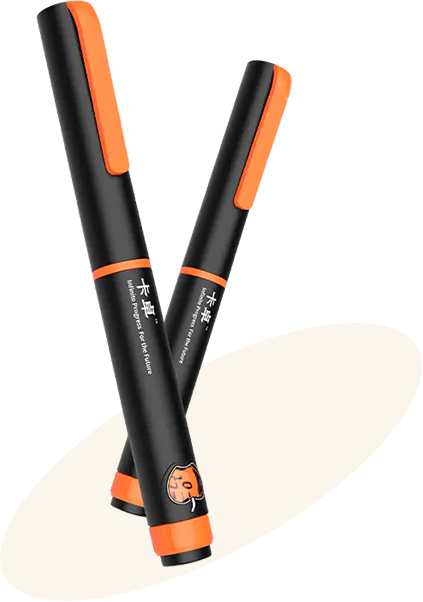 KaZhuo KZB-1R Reusable Manual Insulin PenReusable manual insulin pen for 3 ml cartridges with 1–60 U dose control, built for repeated clinical use and procurement sustainability review.View Product →
Reusability also carries a sustainability argument that procurement teams increasingly have to document. Fewer single-use bodies per patient-year means less clinical plastic waste, and manufacturers with a published ESG position are easier to write into a green-procurement clause; our own environmental and governance reporting is set out in the ESG section.
Most reported errors cluster at three points: priming, reading the dial, and the hold time after injection. A training sequence that treats these as separate checkpoints, rather than one continuous motion, catches them before they reach a patient.
The flow is deliberately short. A four-step routine that staff repeat identically every time beats a twelve-step procedure that gets abbreviated on a busy ward.
Unit price tells you very little about a reusable pen. The questions below are the ones that separate a device that will still be in service in five years from one that will be quietly retired after the first audit.
| Check | Why it matters | What to ask for |
|---|---|---|
| Dial readability | Misread doses cause over- or under-dosing, the most common complaint in the field | A sample pen read at 40 to 50 cm in low light; printed versus moulded numbering |
| Priming behaviour | Trapped air shortens the injection even when the dial is correct | Confirmation that a 2-unit air shot produces a visible drop within three attempts |
| Dose increment and maximum | Paediatric and high-dose adult users need different dial ranges | Stated increment, typically 1 unit, and maximum dose, commonly 60 units |
| Cartridge and needle interface | An incompatible thread or a loose cartridge seat damages the seal and leaks | Needle standard, cartridge format, and a test fit with play measured at the holder |
| Cleaning and labelling | Reusable bodies raise cross-contamination questions during inspection | Written cleaning instructions and single-patient-use labelling |
| Supply and test documentation | A discontinued body strands the installed base; auditors ask for evidence | Cartridge supply horizon, tooling ownership terms, dose-accuracy test reports and the parts of the ISO 11608 series applied |
The supplier side matters as much as the specification. Yongjie (Zhejiang) Industrial Development Co., Ltd. is a Zhejiang-based injection moulder that began as a paper company in 2009, moved into injection moulding between 2010 and 2021, and was formally established in its current form in 2021 with a dedicated engineering team. Its product range covers medical devices, lighting, small appliances and automotive parts, with the insulin pen positioned as the lead medical product.
Two published invention patents sit behind that product line: a reusable portable liquid-material delivery device, ZL202210368411.0, and a single-use equivalent, ZL202210368409.3. The pairing is worth noting, because it means the same developer can support a customer who wants a reusable platform and a customer who wants a disposable one, without either project starting from a blank sheet. Dose accuracy in these devices is a function of the drive train and the cartridge interface rather than the display alone, which is why the mechanics deserve as much attention as the window; our own note on dosing precision in multi-dose injectors walks through the variables that matter.
No manual pen removes the human step, so the risks that remain are predictable. Dose accuracy drifts when the cartridge is nearly empty and the plunger has to travel further against a stiffer seal. A worn needle hub lets the dose leak past the septum. A body wiped with the wrong disinfectant can craze, and a crazed window is a misread dose waiting to happen. None of these are design failures, but all of them appear in complaint logs if the instructions for use are vague.
Two contractual points close most of the gap. Ask for a written cleaning and disinfection compatibility list, and ask for the cartridge supply commitment in years rather than in shipment quantities. Then train against the four-step flow above, with a practical assessment rather than a signature on an attendance sheet. A clinician who can demonstrate priming, dial reading and the ten-second hold has learned the part of the device that no specification sheet can deliver.
A manual visualization reusable insulin pen is a good buy when the window is legible, the priming step is trained and audited, and the consumable supply is committed in writing. It is a poor buy when any one of those three is left to assumption, because the device will do exactly what the user tells it to do, including the wrong dose. Start the evaluation with a sample in the hands of the nurses who will use it, and let their reading of the dial, not the datasheet, settle the decision.

 Custom Pen Compound Syringe Manufacturers